The Great Fire of Winsley

The Great Fire of Winsley – Peter Cross, past Chair and President

Winsley CC in 2003

It was in early 2003 that, following appointment as chairman of WCC, I had a couple of meetings with the President. Dennis Gilmer was also our Landlord. He was lifelong cricket fan and was always keenly interested in everything going on at the cricket club and our plans for the future.

For me Winsley cricket was the perfect village club. I joined in 1992 and I remember in my first league game being approached by one of our players and being informed that I was not mad enough to play for Winsley. About an hour later I was told that he had changed his mind!

 The pavilion was wooden with an equipment shed attached and the facilities might be described as somewhat basic. The water supply lacked any reasonable pressure and there was a complete absence of mains electricity. Occasionally this deficiency was mitigated by a small mobile generator.

It was on the first Sunday after Easter 2003 that our first fixture of the season took place at the Downs. I cannot recall the opposition or the result. Perhaps that was something to do with the fact that the selection committee overlooked my availability!

The Fire

Christine and I had gone to bed and had dropped off to sleep when the telephone rang shortly before midnight. It was the President in a very agitated state telling me that the pavilion was on fire. We a rushed to the Downs to find that Jean and Keith Potter were already there. Soon the fire brigade arrived.

By this time the fire had taken complete hold of the pavilion and the roof had already gone. The fire brigade then discovered that they could not get their engine onto the ground because the gate was mounted parallel to the lane. This further delayed them as they had to run their hoses across the outfield.

The next major concern was the existence of the gas canisters that were located outside next to the kitchen window. They were kept cool by constantly dousing them with water.

The pavilion was by now little more than a burnt out shell. We had lost most of our cricket kit and all of our machinery apart from the outfield mower (which had been stored outside).

The leading fireman thought that this fire was the handiwork of a teenage arsonist. He thought it likely that the culprit would be hiding in the nearby woods to view the spectacle. He went to the fire engine to collect his infra red binoculars – only to discover that it had been left in the fire station.

By about 02.00hrs it was all over and we were left to contemplate the future.

The Club Pulls Together

It was arranged that on the following evening we would hold a meeting of the whole club at the Town Club in BoA. Inevitably there was considerable dismay at the misfortune that the club had suffered. Nevertheless it was decided that we would rebuild. We had no idea what form it would take and how it would be financed. In reality we had only two options. Either we could dissolve the club or get on with a rebuild. At least we had a ground!

Then another disaster struck. The following evening we learned that our prime supporter, president and landlord, Dennis Gilmer had died suddenly.

Recovery

After such a traumatic few days, we needed some time to plan and there was cricket season to prepare for.

The immediate priority was to instal a temporary mobile building to provide some shelter and changing facilities. In order to improve the access to the site, Bob Harford altered the angle of the entrance gate (at the angle it is today).

Several weeks later we had a meeting with the Gilmer family and they were very supportive of our decision to rebuild at the Downs. So much so that they increased the size of the outfield by taking a small piece of land from the field between the ground and the manor. Arguably of more importance was that they agreed to extend the term of the lease from the, then current, 15 years to 40 years. Without this increased security of tenure building a new pavilion was not a viable proposition.

What would a new pavilion look like? At this point our fortunes started to improve. A local architect offered to design a new pavilion free of charge. What an offer! After some discussions by mid summer the new design was available and it was duly submitted to Wiltshire County Council. In addition our architect recommended a suitable building regulations inspector. He came from Cardiff and did the work for free. It emerged that his father had lived in Winsley and had even played for the club – albeit a few years ago.

Then we had an offer from a local builder to construct the building at a very favourable rate provided we provided the labouring support. Things were looking up!

Whilst we had insurance cover for the original wooden pavilion and its contents, it was only to the sum of £37K. The urgent need was for machinery to mow the pitch etc. Even worse we discovered that the insurance company would only pay up on supply of an appropriate receipt. A cash flow issue that we didn’t need!

The original wooden building was pretty basic when it came to services. Cooking and hot water was derived from gas bottles and the water supply pressure was minimal. The supply pipe was partially blocked. During late summer we dug a new trench from the gate to a shallow pit by the site of the new pavilion and laid a new plastic water main. Then we dug a new trench diagonally across the manor field to the electricity pole adjacent to the manor entrance and arranged for a new supply. The electricity supplier was a bit dubious about connecting it up when they discovered that the associated building did not yet exist. The meter was installed in a cupboard approximately where the all weather net is now. These services were essential support for the construction works.

Our club secretary, Peter Mundy got to work contacting local cricket clubs, friends etc. asking for practical help.The response was three dimensional. Some never responded. Some expressed sympathy but could not offer any practical help but then a few stars emerged. Somebody lent us a dumper truck for the duration of the build. Another offered us the blocks at less than cost price and finally somebody from a company manufacturing plaster board offered us as many as we might need. A couple of weeks later 250 sheets were delivered!

We also contacted Sport England to enquire whether we might be eligible for financial assistance. The answer was negative. The reasons were associated with the fact that funds had already been allocated to other multi sport venues in the area. Also we were informed that our post code meant that we should be able to fund it ourselves!! At this point we contacted Andrew Murison (then our MP). He wrote to Richard Caborn, the sports minister, and received a reply to the effect that their policy was only to support “elite sports”. Mr Murrison’s reaction was almost unprintable.

We got to the point where the cricket started in the spring of 2004 with a shell of a pavilion with no doors or windows but we had a pavilion! By early summer these vital components had been fitted and we were ready for the official opening.

After all this we decided that we should just get on with it. The whole club pulled together. Some worked very hard digging holes, driving the dumper truck etc. Others put their hands in their pockets and somehow the building took shape. A real example of “five loaves and two fishes”. In early summer the pavilion was sufficiently advanced to enable a formal opening. Mr Murison kindly agreed to “do the honours”. He arrived and expressed amazement at what we had achieved.

Finally several years later we received a grant from the foundation for the Sports and the Arts. This funded the installation of a hot water and heating system for the pavilion.

The Ground

It was a couple of years later when the Gilmer family approached with a proposal that we should purchase the ground. It was agreed that a fair price would be £35K. However the club was still rebuilding finances after the completion of the building works. We looked at raising a bank loan but the requirement for collateral proved to be a stumbling block.

The apparent impasse was broken when the residents of the manor suggested that we could buy the land together. Hence a limited company was formed with five shareholders (the club having one share). The club now had only to find a fifth of the purchase price and the ground was leased back to the cricket club for 199 years at rent of one peppercorn per annum.

Thus the future of the club on the Downs was finally secured.

Conclusion

So there is the story of Winsley CC’s pavilion rebuild. Quite how we did it I am not sure. However there is no doubt that it happened through the determination and hard work of many of the members.

Then there are those that have supported us throughout this story – whether members or just well wishers.

I have not mentioned most of them by name for fear of missing out some but those involved will know who they are.

I hope that all those who play for Winsley in the years to come will remember this story and use it to inspire them in their cricket and in the development of the club overall.
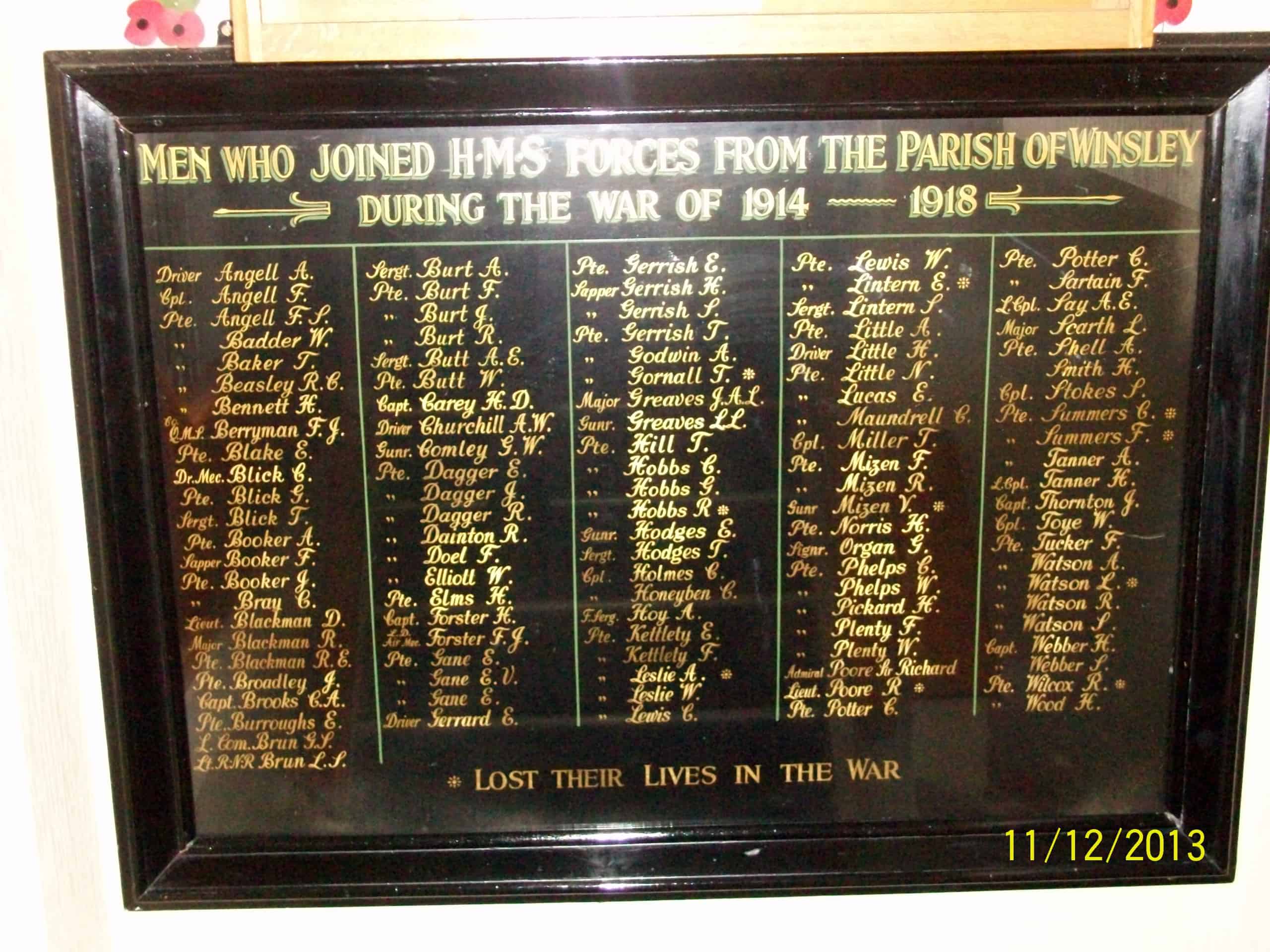
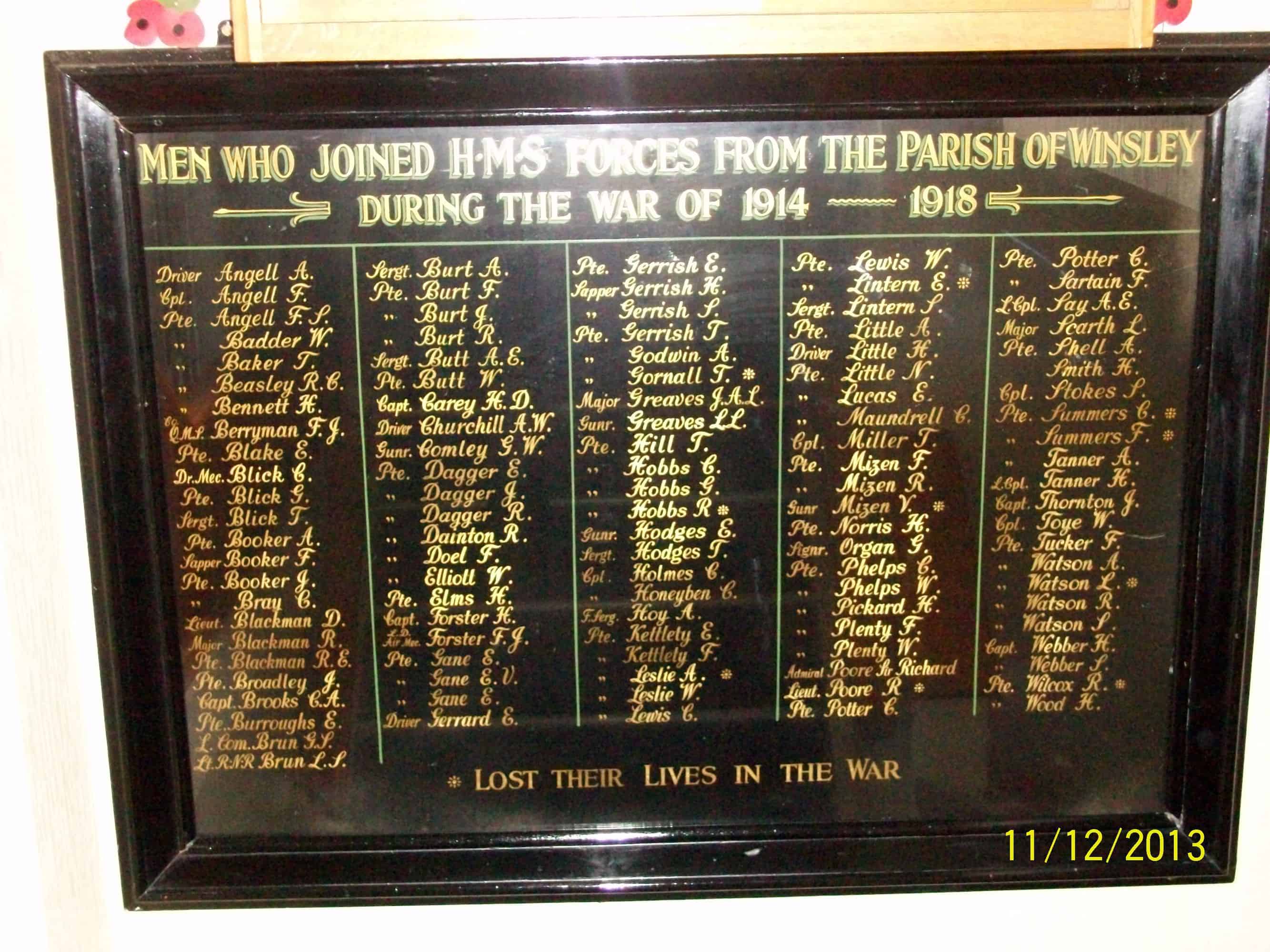
 

Display board with names of those in H M Forces from the Parish of Winsley who died in World War 1 (Village Club)

Winsley at War

Winsley at War

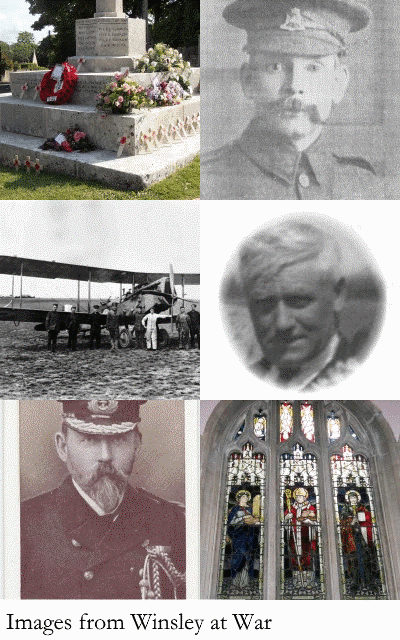
honours-boardDuring World War One, from the Wiltshire village of Winsley and neighbouring Turleigh, Conkwell, Murhill and Hartley, 113 men served in the armed forces. The names of these men are remembered on the Honours Board currently displayed in Winsley Village Club situated in the old school building.

Pictures from press releaseResearch has been carried out on each name to find where each person lived and what they did before, during and after the War. Information has been found on the vast majority of those that served, though some proved elusive.

One man went on to became Chairman of Yeovil Town Football Club, another built Winsley Village Hall and a third developed the Turleigh Reading Room.

The results of this research can be found at: https://winsleyatwar.wordpress.com/

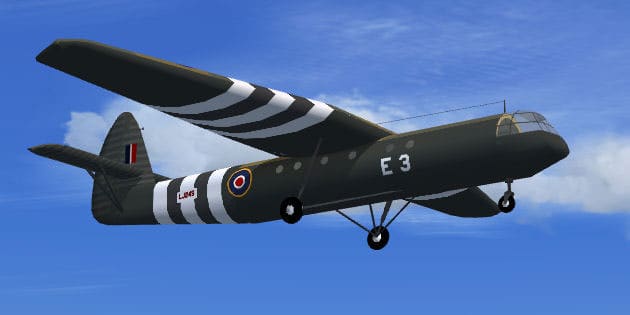
RAF Horsa Glider from World War 2

Making History: Tony Kemmery’s Story – Part 2

Making History, Tony Kemmery’s Story Continued

Interview by Carole Rowe

Last month’s account narrated Tony’s experiences as a D-Day veteran. Demobilisation began a month after Germany’s surrender in May 1945; hoping his war was over, Tony looked forward to returning to Civvy Street. This was not to be. Instead, still a member of the RAMC, he was deployed to the British Mandate of Palestine, placing him yet again into the front line. By 1945, British rule in Palestine was becoming critically unstable. The Jewish goal of establishing a nation state was being pursued with ever-increasing militancy and violence.

At first based at Netanya (Camp 21), an Arab farming village, he was soon transferred to work in the dispensary of the 16th General Hospital in Jerusalem – ‘a wonderful position’ (his description) near the Mount of Olives. After a year, his senior manager was demobbed and Tony was the intended replacement, but he needed to obtain the Army Dispensary Qualification. Acquiring this involved a “searching” interview – with questions that conveniently avoided anything he didn’t know – and a formally invigilated written examination, which he completed in only 30 minutes! Needless to say, he passed and went on to manage the dispensary, promoted to staff sergeant, for the next 18 months.

During disturbances, such as the bombing of the King David Hotel, July 1946, which he witnessed from a dispensary window, he was confined to barracks. In more peaceful periods, the Army became a tour operator, organising sight-seeing trips for military personnel. Tony visited Nazareth, swam in the Dead Sea, explored a Crusader castle. He spent Christmas in Bethlehem and had two weeks leave in Beirut. He was left with many impressions, recalled with both affection and sadness. Smiling, he described seeing village houses built out of empty British petrol cans; recounting his arrival in Gaza, he paused in our conversation to remark, quietly, “Then it was a small Arabic town; now it is at the centre of things.”

At last, his demob date came through – March ’47. The Army wished to retain him as dispensary manager and offered promotion to warrant officer, if he agreed to sign on for a year. Tony, feeling this would be too long, refused and left for home.

The return trip proved quite eventful. Due to sail from Port Said, he learned that his troop ship had broken down, leaving him stranded, with very little local money. Finally, he sailed for Britain, which was enduring the savage winter of ’46-’47. Approaching Liverpool, he was shocked to see the north Wales coast white with snow and regretted turning down the offer of buying his Army greatcoat for a pound – but, as he said, ‘a pound was a pound.’ Officially demobbed at York, he took the night train to Bristol, which became marooned in snowdrifts in the Midlands, without light and bitterly cold, for six hours!

Tony had clearly experienced much during his military career. He had enjoyed seeing so much of the world (especially the Middle East) and valued the companionship he found – up to 20 years ago there were regular reunions of his comrades. Tending to the wounded was inevitably harrowing, but he said, ‘You get used to it.’ Sometimes, seeming tragedy was averted: during the Rhine landings (1944) a glider carrying soldiers from the Anti-Tank Regiment landed off-target and careered through a narrow village street, its wooden wings torn off by the impact. Tony feared finding dead or seriously-wounded casualties in the fuselage, but its occupants were completely unscathed!

Sadly, some events took a darker, unexpected turn. In 1945, while unloading a jeep and trailer from their glider, Tony and his companion, a corporal, came under fire from the German Home Guard. The corporal was wounded, although not apparently seriously. He was stretchered, with Tony’s help, to a casualty clearing station. Two months later, with sadness, Tony learned that his comrade had died in hospital.

In total, over 6 million British men and women served in the Armed Forces between 1939 and the establishment of Israel in 1948. Each of their accounts is unique; as such, it is a privilege to have had the opportunity to record Tony Kemmery’s story.

RAF Horsa Glider from World War 2

Making History: Tony Kemmery’s Story – Part 1

Making History: Tony Kemmery’s Story Carole Rowe

On 6th June 1944, an Allied force of 156,000 American, British and Canadian troops stormed the Normandy coast in the biggest amphibious invasion in history. ‘Operation Overlord’ was meticulously planned and daring in its simplicity. Landings took place on five main beaches, code-named Utah, Omaha, Gold, Juno and Sword. From these beachheads began the liberation of Europe; eleven months later, Germany finally surrendered. Winsley resident, Tony Kemmery (now 91), vividly remembers his part in these momentous events.

In the very early hours of D-Day, Tony was in one of the more than 300 wooden Horsa gliders being towed by bombers across the Channel towards Normandy. His civilian qualification as a Pharmacist on hold, he was now a member of the Parachute Field Ambulance, a division of the Royal Army Medical Corps attached to the 6th Airborne Division. About six miles off the coast, his glider was released and it flew, as he recalled, creaking and groaning, over the German ‘Atlantic Wall’ defences to land about a quarter of a mile from the now-famous Pegasus Bridge. Orders were straightforward: to take and hold this vital crossing over the River Orne until relieved, thus protecting the landing forces at Sword beach. The calculation, which was proved correct, was that the German defenders, caught unawares, would not have time to foil the attack by blowing up the structure. The medical unit was to take cover until the crossing was secured by infantry; then move across, protected from enemy fire by the bascule bridge’s metal construction and surrounding ditches. Tony instantly recognised his surroundings from the models shown in the pre-op briefing and was able to forge ahead to the nearby village of Ranville and the château destined to be the field hospital.

The Germans managed to regroup and the Allies did not break through until August. Therefore the château, its roof draped in a Red Cross flag, became Tony’s base for some time. Initially, the two operating teams and support staff were at full stretch; later, the volume of casualties varied. On ‘quieter’ days, men were kept busy (‘Army Bull’, as Tony remarked) in other ways, for instance creating and equipping new fire points in the building. He re-visited the village in the 1960s with his wife, Sylvia; the château was undergoing renovation and, to his amusement, the scraped back wallpaper in the entrance hall had revealed a fire point he had helped to install.

The inhabitants of Ranville, technically the first village to be liberated on D-Day, were very welcoming of the Allied personnel. Tony fondly remembers a local café, where he and his friends were fêted with ‘slap-up meals’ of local produce. There was an equally warm reception on his return there two decades later: the owner’s son, now running the business, refused payment for the meal Tony and Sylvia had eaten and drove them to Bayeux’s military cemetery to enable them to place flowers (paid for by the Frenchman) on a family grave.

By the autumn of ’44, the German forces were pulling back in the teeth of the Allied advance. Due for leave, Tony was briefly repatriated, sailing from the Mulberry harbour at Honfleur and returning to his base at Bulford. On Christmas Eve, his parents eagerly expected his arrival at the family home in Bath. However, at the last minute, leave was cancelled and, instead, the night of 24/5th December found him flying out to the Ardennes, the arena of the Battle of the Bulge. As his medical support training had included a wide range of skills (the principle being that he might be on his own with a casualty), Tony was deployed in many different rôles. For two weeks in January 1945, he worked as part of a field ambulance resuscitation team. (‘Resuscitation’, as he recalled, often equalled hot sweet tea, a warm blanket and a blood transfusion.) By March, as the Allies advanced, he was helping to man a casualty clearing station near Cologne. Finally, he returned to Bulford, thinking, That’s it! However, his story was to take a totally unexpected direction – to be continued in the following article!

St. Nicholas Winsley

A History of St. Nicholas Church

The Building

It is recorded that in 1155, a survey showed two monks living in Winsley, although they may have been farm labourers, but an even earlier survey of 1135 did not mention the monks. According to the records of Shaftesbury Abbey a monk lived in or nearby in 1170. The vicarage in Bradford on Avon has a record dated 1349 mentioning a chapel in Winsley.

At the time of the dissolution of the monasteries, the chapel was granted to the Dean and Chapter of Bristol in 1542.

Winsley had a Curate in 1628 and he enjoyed small tithes.

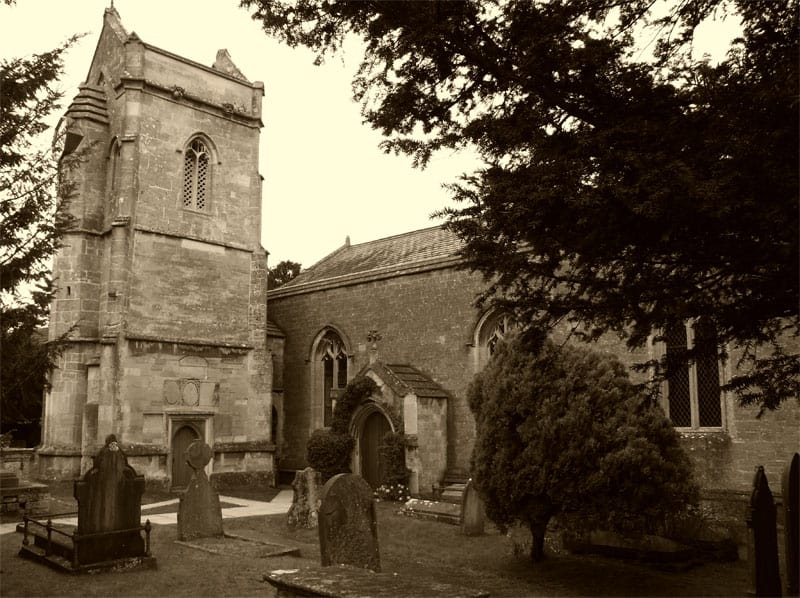
As the population of Winsley grew, so did the Church membership and in 1841 a new Church was built, still keeping the 16th century tower which now joins the Church by a little arch.

The new Church was one of a number rebuilt by the order of Rev. Harvey of Bradford on Avon. This action created employment at the time the weaving and quarrying went into decline and served to replace the original building which had fallen into disrepair.

One of the basement stones on the tower is referred to have been dated 1161 but this information is dismissed and more correctly stated 1761 or 1765.

The Tower houses 3 bells which were installed in 1951 and today are used for “swing chiming”. The Church clock dates from the late 18th century (although some information suggests it might be 100 years earlier) and was converted to an electric movement in 2004 following a generous donation in memory of Capt. Edward Harrison Johnson R.N.

A stool was made from the original Church Doors and was in the possession of the late Mrs Baker whose husband was Vicar of Winsley (1922 – 1961)

———————————————————–

Inside the Church

The interior of the Church is very interesting, the gallery now houses the organ, above the medieval font and the altar between the Ten Commandments below which the Lord’s Prayer and the Nicene Creed. The church kneelers are very colourful and include the Magi, Samson and Lion, Lifeboat Institute, Mothers Union Lilly, copy of the Church porch, Five Loaves and Three Fishes, Penguin and Puffin, Noah’s Ark, the Wise Men, Tree of Life, Cross and Tudor – Rose. They were made by Parishioners and dedicated in 1969. The Altar kneelers were also made by Parishioners and dedicated in 1992.

A plaque on the wall opposite the door records the building of the new Church in 1841 although with less seating than the original. At this time pew rents were payable being abolished in 1889.

The coat of arms on the gallery front is from the time of one of the Georges.

The reordering of the East End of the Church was completed in 1990. This involved the removal of stonework and brass rails and replacing with a modular polished wooden platform system. This adds to the flexibility of the Church by way of accommodating alternative styles of worship. It also allows the Church to be used for music performances.

At the Chancel area a Bishop’s chair can be seen, in memory of Charles Sylvanus Meech, inscribed on it is:-

Latin                 Aalbet cum Deus            MDCCXLI Paroch Winsluens

English            God saved him                 1841     Parish of Winsley

Latin                 Dapacem Domine Vicar Bradfordens

English            Give peace on earth            Vicar of Bradford

Charles Sylvanus Meech was a Curate of Winsley

———————————————————–

In 1984  St. Nicholas Winsley combined with  St James, South Wraxall and St Peters Monkton Farleigh to become the Benefice of St. Nicholas, St. James and St. Peter.

In 2010, the “Benefice of North Bradford on Avon and Villages” was formed and St. Nicholas,  St James, South Wraxall and St Peters Monkton Farleigh were joined by Christ Church Bradford on Avon.

The following is a summary from the vestry and Parochial Church Council Minutes and Account Books.

  • 1844 Trees planted round edge of “Chapel” yard
  • 1846 Organ installed
  • 1877 Church first insured for £800
  • 1889  Church reseated with pitch pine pews, kneeling boards etc. and restored at a cost of £408.4.6
  • 1898 Choir stalls of pitch pine placed in Church £8
  • 1904 A flag staff erected on the Tower, not on the top, but at an angle through the dormer door with base inside the Tower
  • 1923 Oak Eagle Lectern given to the Church in memory of Miss Cornwall. It was carved during the First World War by a Belgian refugee
  • 1924 Solid fuel boiler and hot water pipes installed
  • 1924 Folding wire gates installed at outer entrance or porch to keep out dogs and enable Church doors to remain open in summer
  • 1924 Electric light installed to replace oil lamps, 19 lights in total cost £52
  • 1926 Stained glass window at East given in memory of the late Rev. R.W. Angelsmith, former Vicar of the Parish
  • 1947 Electric blower for organ installed
  • 1956 New copper weathervane in the form of an arrow erected on the Tower
  • 1967 Oil fired central heating installed
  • 1971 Mains water connected
  • 1973  Interior of Church redecorated
  • 1981 Church re-roofed
  • 1982 Church rewired
  • 1987 Gas fired central heating installed
  • 1988 Tower re-roofed
  • 1988 14 Japanese oak candle holders mounted on walls
  • 1990 Monthly “Parish News” introduced
  • 1990 East End of Church reordered. Wooden modular platforms installed to replace stone and brass chancel structures. Church redecorated.
  • 1998 Rebuilding of organ
  • 2004 Front rows of pews removed and replaced with chairs
  • 2007 Churchyard grass cutting contracted out and funded by Parish Council.
  • 2009 Church redecortaed and new lighting system installed.

The Churchyard

In the Churchyard yew trees can be seen, one was taken from what is now Dorothy House Hospice (formerly Sutcliffe School) and planted in its present position along with a number of others in 1844 at the cost of the Church by a William Stone.

St. Nicholas Churchyard contains the mortal remains of residents going back some 400 years. In addition there are three World War 2 “war graves”.

During the course of every year visitors from far and wide come to the Churchyard seeking out the graves of long passed relatives or friends. These are in addition to the more local who visit regularly to tend the graves of their more recent lost loved ones.

Today the Churchyard grassed areas are maintained under a contract funded by Winsley Parish Council. Regular working parties helping with general maintenance are held seasonally.

By the door inside the Church a board of Vicars can be found, the board is in memory of Rev Homer Hill and given by his wife and son,

it reads:

  • Lewis R Cogan – 1846
  • Francis S. Forcess – 1862
  • Reginald W.A. Angelsmith – 1892
  • T. Francis Baker – 1922
  • Homer Hill – 1961
  • William A. Matthews – 1973
  • David Ritchie – 1981
  • Derek Smith – 1984
  • Robert Green – 1999
  • Howard Jameson – 2005

The Medieval Font was found in a nearby garden although it had probably been used in the Church previously.

In 2004, a faculty was granted for the provision of 40 chairs to replace 6 pews in the front of the Church. These were funded by individual donations at no cost to the Church. They were manufactured and supplied by the Church Furniture Specialist “Irish Contract Seating” and are of a link seat design.

In 2006 a “Railway” style clock was erected in memory of the late Mervyn Hallbrook, Verger for St. Nicholas Church from 1968 – 2005. His picture is displayed at the back of the Church alongside a montage of pictures of previous Clergy.

The Organ

The Church organ originates from 1876, when it was ordered from J.Halshaw & Sons of Birmingham. It was constructed on the gallery at a cost of £200 and comprised:

Great Organ – 6 stops. Swell Organ – 4 stops. Pedal Organ – 1 stop. Hand pump.

By 1922 it had deteriorated and was dismantled, repaired, cleaned and resited

away from the west window at a cost of £102.10.0. Further repairs and improvements were made in 1931 which included lowering the pitch of the organ, making a curved pedal board and a general overhaul.

In 1947 electrical blowing equipment was installed.

During 1960 a further overhaul became necessary including the replacement of the split wind chest tables and stripping and cleaning the keyboards.

Despite further maintenance, by the end of 1994 it was clear that the organ was ailing and had suffered the ravages of time and variable quality of workmanship. In May1998 it was completely dismantled, 700 pipes removed and cleaned, refurbished and adjusted. The pedal systems were all refurbished, several stop heads were newly engraved in Gothic script. The restoration was completed in September 1998 at a total cost of £9000. Half of the cost was funded by the Foundation for Sports and Arts which itself is funded by subscriptions from Football Pools, Vernons, Littlewoods and Zetters.

Gifts in Memory

Further examples are:

The East Window depicting St.Cecilia, St. Nicholas and St. George was given by Dr. & Mrs. Webber of Turleigh House in memory of their daughter Consatnce and younger son Capt. Sydney Webber D.C.L.I. in 1926

The oak altar was given by Mrs. Dorothy Baker in memory of her husband Rev. Thomas Baker (vicar from 1922 – 1959) in 1962

The chancel cross was designed and made by Mr. Les Butler in 1989 and the gold leaf on the cross was provided by Mrs. Trixie Sampson

The hymn board was given in memory of Flt. Lieut. Oliver Rayner Matheson RAFVR, DFC, Pathfinder

Today

The Church is now equipped with sound amplification and a loop system  for the hard of hearing. The combined Parishes are now under the care of a Rector supported by a non-stipendary minister and lay readers. There is a Parochial Church Council which includes 2 Churchwardens, Treasurer, Secretary, Deanery Synod and  ordinary members.

The services are varied and details are published in the weekly notices  on the Church notice board and the Parish Website. Youth programmes are well supported under the guidance of a Youth Officer with voluntary assistants. Regular “social” events are organised. These are associated with religious festivals charitable causes or just “getting together” The Church is regularly used for musical performances and concerts.

Winsley archives

There are Winsley archives on the Bradford museum website.

Please click here for more information

Bradford on Avon Museum
Bradford On Avon Library
Bridge Street, Bradford On Avon, BA15 1BY

Click here for directions

road sign

My Eighty Years in Winsley. By: Bert Bowles

I was born in 1931 and like my father and grandfather I have lived all of my life here in Winsley. My Grandfather, Abel, was a farmer at Parsonage Farm on the road to Conkwell, but his business was a victim of the farming recession in the mid 1800’s. He then lived in Conkwell, working as a farm hand and raising his family of eight children. My father, Herbert, started work in 1890, aged eleven, on a farm at Claverton on the A36. His walk to work took him through Warleigh and across the river on a ferry at Ferry Lane. The journey was considered so long that he was allowed home every other week end!

His business career started in 1900 when he became the Landlord of the Seven Stars here in the village. In those days the village was a busy mining community and his trade was dependant on the thirsty miners and the many small farms from the surrounding hamlets of Conkwell, Ashley, Haugh and Turleigh. The busy mine at Murhill was the main employer, and when you visit the mine entrance you can easily imagine the hive of industry, and still see the route of the rail track that took the stone down onto the canal. Apparently, the track was a loop, whereby the weight of the full trucks going down pulled the empty ones back up and the only energy required was to operate the breaking system. Once on the canal the stone went all over the country, and just off Oxford Circus in London, you can find Winsley Street which I understand is named after the village from which the stone to build the area was sourced.

As a child, I was told many stories of those days. My father brewed his own beer at the pub and sold his Best Ale for a halfpenny per pint, and the ordinary for a farthing. Apparently the village policemen would do his rounds at 10;30pm  each evening and a pint of best always left on the stone mounting block on the road side, to ensure there were no misunderstandings about closing times!

The local farmers would milk their cows in the morning, load the milk onto their horse carts and rendezvous at a milk collection point in the village. From there it was taken to the milk factory at Staverton. For most farmers, the only source of fresh water was at Turleigh Trows, so they would then continue on there to refill their milk churns with water, before returning to the farm for a day’s work. However, for some characters a brief stop in the ‘Stars’ was too tempting! There they would discuss the issues of the day and the arguments would become more passionate as each pint went down. The journey home was navigated by the horse and I was told it was not uncommon to find the farmer asleep under a hedge or stone wall around the lanes, while the horse grazed the grass verges.

Just after the First World War, my father realised his ambition and left the pub to start farming at Church Farm. My early childhood memories were of life on the farm during the Second World War. I remember the anti- aircraft guns and searchlights in the fields on the road to Conkwell, the air raid warning sirens from the Winsley Hospital (now Avon Park) and the prisoners of war working on the farm. There was a great community spirit despite the difficult times and I remember the whole village school being sent onto the farm at harvest time to help comb the fields for an ear of wheat or potato that was missed by the farmhands. The scarcity of food was on eveyone’s minds, and I remember when a pig was ready for slaughter, the whole village seemed to know about it and it became a community event on the farm. Everyone helped with the process in return for their rare pork supper. The village centre was the Church, Pub and School (now the Social Club) and many trades were based at the Manor, from where the local Blacksmith and Farrier worked. The Hospital site was also a large local employer as the nation struggled with the ravages of Tuberculosis. The fields between the road and the hospital were markets gardens and always full of gardeners producing food for the patents and many local people worked on the site as gardeners and maintenance staff.

The village started to grow rapidly in late 1940,s when the area from King Alfred’s Way through to Dane Rise was built. Its now hard to imagine that the small road which leads to the Church Yard was then the main road to Conkwell and the access for lorries delivering to the farms. The building of the Tyning Road area in the early 70’s and then the bypass completion in the 80’s means the Village is now much bigger than the one I grew up in. In those days a strange face was a talking point and a car passing through was the event of the day. However, as my grandson Tom now builds his business in the community I can’t help thinking that ideas like ‘localism’ and ‘carbon friendly’ are only new words to describe the old ideas. Perhaps we are just going round in circles?